
Dental Implants: How the Procedure Works and How Long They Last
A dental implant is the most natural way to replace a missing tooth. Here we explain the stages of treatment, how long it takes and what determines how long an implant lasts.
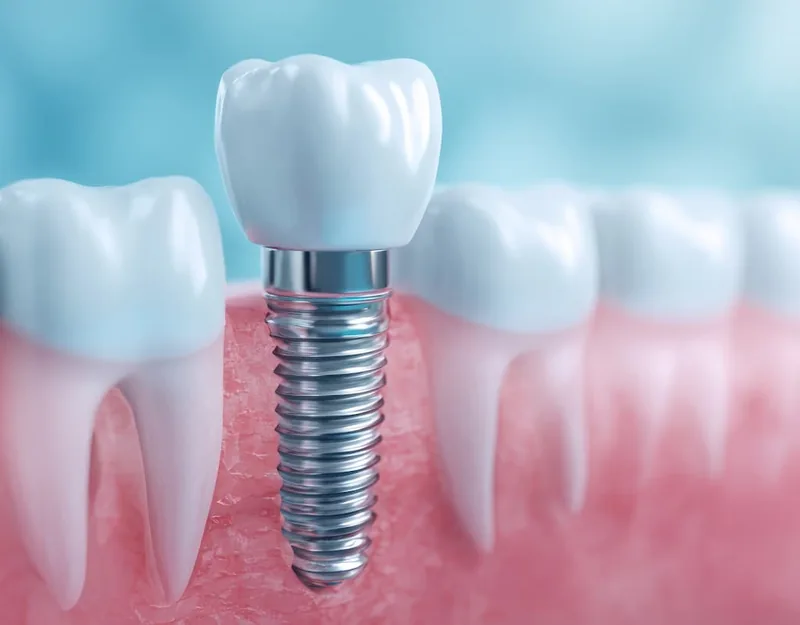
What is a dental implant?
A dental implant is a small screw, usually made of titanium, that is placed in the jawbone and takes over the role of the missing tooth’s root. Once it has fused with the bone, a connector (abutment) and a crown are attached to it, looking and working like a natural tooth.
Unlike a bridge, an implant does not require grinding down the healthy neighbouring teeth, and it transfers chewing forces to the bone, which helps preserve it.
Stages of implant treatment
Consultation and diagnostics
The doctor examines you and assesses the condition of the bone. This often requires an X-ray or a 3D CT scan (CBCT). Information about your general health is also important.
Treatment plan
An individual plan is drawn up: the number and position of implants, whether bone grafting is needed, the timeline and the cost.
Implant placement
The procedure is performed under local anaesthesia, so you will not feel pain during it. Placing a single implant usually does not take long.
Healing
The implant gradually fuses with the bone. This period usually lasts several months and depends on the bone quality and the implant’s location. If needed, you can have a temporary tooth during this time.
Crown placement
After healing, the prosthodontist makes and fixes a permanent crown that matches your teeth in colour and shape.
In some cases a temporary tooth can be fixed on the implant right after placement. Your doctor will tell you at the consultation whether this is suitable for you.
How long does an implant last?
A properly placed implant, with good hygiene and regular check-ups, lasts many years, often decades. Studies show that the vast majority of implants are still functioning successfully 10 years after placement.
The crown on the implant takes daily chewing load, so after some years it may need replacing – without replacing the implant itself.
What affects how long an implant lasts
Hygiene
Inflammation of the gum around the implant (peri-implantitis) is one of the main causes of implant loss. Daily cleaning is essential.
Smoking
Smoking makes healing harder and increases the risk of complications.
General health
Uncontrolled diabetes and some other conditions affect healing, so always tell your doctor about your medical conditions and medications.
Who is implant treatment suitable for
- You have lost one or more teeth
- You don't want healthy neighbouring teeth ground down for a bridge
- You are bothered by a removable denture that moves
- You want a fixed restoration of a completely toothless jaw
If there is not enough bone, a bone grafting procedure is often possible. Your doctor will give you an exact answer after diagnostics. At Smile Care, implant treatment is performed by implantologists Givi Benidze, Zurab Sheqiladze and maxillofacial surgeon Sopio Chikobava. Learn more: Dental implants at Smile Care.
Frequently asked questions
Is getting an implant painful?
The procedure is performed under local anaesthesia, so you will not feel pain during it. Any discomfort afterwards usually passes within a few days and is managed with ordinary painkillers.
How long does the whole treatment take?
It depends on the bone condition and the complexity of the case. Healing usually takes several months. Your doctor will set the exact timeline at the consultation.
How long does an implant last?
With good hygiene and regular check-ups, an implant lasts many years, often decades. The crown may need replacing after some years.
Can an implant be placed if there is not enough bone?
Often yes – after a bone grafting procedure. The doctor assesses this based on a 3D CT scan.
This article is for information only and does not replace a consultation with a doctor. Your doctor will choose the right treatment for you after an examination.
Book a consultation
Leave your name and phone number and we'll get back to you. Or call us: 032 250 00 48
Mon–Sat: 10:00–20:00 · Sun: closed
6a Simon Kandelaki St · 25b Adam Mitskevich St